


Updated . Published .
GIA Certificates: How to Read a GIA Report and What to Avoid
A GIA report, often called a GIA certificate, is the grading document the Gemological Institute of America issues for a diamond. It lists the report number, shape, measurements, the 4Cs, polish, symmetry, fluorescence, proportions and a map of the inclusions. Verify the number with GIA first. Then read the grades, the plot and the comments before you buy.
- Check every report number on GIA Report Check or in the StoneAlgo Diamond Check.
- The 4Cs in section 2 set most of the price. Polish, symmetry and fluorescence in section 3 fine tune it.
- Read the comments. "Clarity grade is based on clouds that are not shown" is a warning sign at SI1 clarity or lower.
- GIA gives a cut grade only to standard round brilliant diamonds.
- GIA reports for lab grown diamonds now use "premium" and "standard" in place of color and clarity grades.
Check your diamond Search diamonds
What is a GIA report?
The Gemological Institute of America (GIA) grades diamonds in its labs and records the results in a report. Many sellers call it a GIA certificate. The report describes the diamond's quality. It does not state a price or value.
Each report has its own number. You find it at the top of the report and in the first section. GIA often laser inscribes the number on the diamond's girdle (its outer edge) in tiny print. On our example report below, the inscription reads "GIA 2416541737".
Smaller diamonds often come with a GIA Diamond Dossier. It is a shorter report with no clarity plot, and the report number is laser inscribed on the girdle.
How do I check a GIA report number?
- Find the report number at the top of the report. If the diamond is inscribed, a jeweler can show you the same number on the girdle under a loupe.
- Enter the number on GIA Report Check. Make sure the carat weight, grades and measurements match the report you were given.
- Enter the same number in the StoneAlgo Diamond Check. It shows a fair price estimate, the visual carat weight and, for round diamonds, the cut score.
- If any detail does not match, stop and ask the seller before you pay.
The 8 sections of a GIA report
Our example is GIA report 2416541737, issued on December 7, 2021, for a 1.15 carat round brilliant diamond with G color, VS2 clarity and an Excellent cut grade. We numbered its 8 sections.
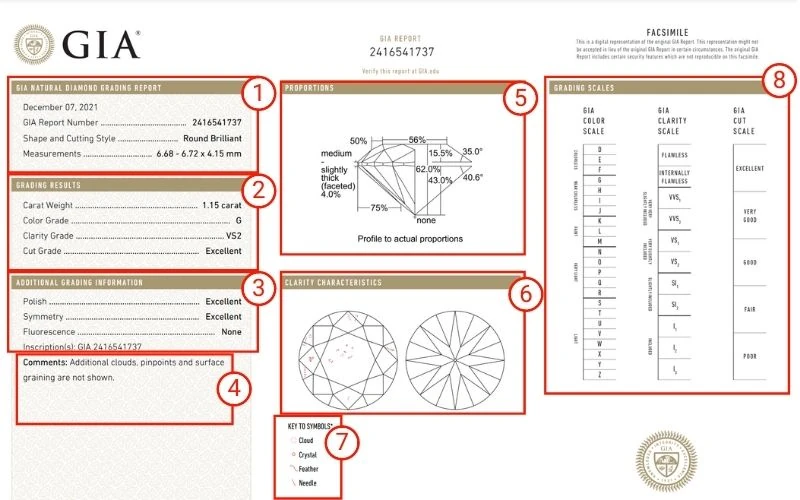
| Section | What it shows | What to check |
|---|---|---|
| 1. Report details | Date, report number, shape and cutting style, measurements | The number matches GIA Report Check and the inscription |
| 2. Grading results | Carat weight, color, clarity, and cut for round diamonds | The 4Cs fit your budget and goals |
| 3. Additional grading information | Polish, symmetry, fluorescence, inscription | Excellent or Very Good polish and symmetry |
| 4. Comments | Notes that the plot cannot show | Clouds that are not shown, at SI1 or lower |
| 5. Proportions | Table, depth, crown and pavilion angles, girdle, culet | The cut score for round diamonds |
| 6. Clarity characteristics | A map (plot) of the main inclusions | Large inclusions near the center of the top |
| 7. Key to symbols | The inclusion types, most important first | The first item on the list |
| 8. Grading scales | The GIA color, clarity and cut scales | Where your grades sit on each scale |
1. Report details: number, shape and measurements
- GIA report number: the diamond's unique ID. It ties the physical diamond to its GIA grades.
- Shape and cutting style: the outline (round, oval, pear and so on) and the facet style. Some shapes, such as cushion cut diamonds, come in several styles, for example brilliant and modified brilliant.
- Measurements: length, width and depth in millimeters, in that order. Our example measures 6.68 to 6.72 by 4.15 mm.
Our advice: Shape is personal taste. Round is the most popular shape, and some buyers prefer an oval, marquise or asscher. Watch the measurements, though. A diamond cut too deep looks smaller than its weight, and a shape that is too long can look odd. Our visual carat weight score flags these problems, and you can check it for any GIA number in the Diamond Check.
2. Grading results: the 4Cs on a GIA report
- Carat weight: a unit of weight. One carat equals 0.2 grams, according to GIA. Two diamonds of the same weight can look different in size because of their cut, so check the length and width too.
- Color grade: GIA grades color from D (colorless) to Z (light yellow or brown). Most diamonds in jewelry fall between D and K. Read our diamond color chart for each grade.
- Clarity grade: how visible the inclusions and blemishes are, from Flawless (FL) down to Included (I3). See our diamond clarity guide.
- Cut grade: GIA grades cut only for standard round brilliants, from Excellent down to Poor. Fancy shapes such as ovals and cushions get no GIA cut grade. For round diamonds, StoneAlgo adds a diamond cut score on a 10 point scale.
Our advice: For most buyers we suggest color D to K, clarity FL to SI1, and only Excellent cut for round diamonds. Carat weight is up to you. Look for a diamond whose actual carat weight is close to its visual carat weight. That usually means the cutter aimed for sparkle over extra weight.
3. Polish, symmetry and fluorescence
- Polish: how smooth the facets are after cutting. Grades run Excellent, Very Good, Good, Fair and Poor.
- Symmetry: how evenly the facets line up. A diamond with Fair or Poor symmetry can look lopsided.
- Fluorescence: a glow, usually blue, that some diamonds give off under ultraviolet light. GIA reports it as None, Faint, Medium, Strong or Very Strong.
Our advice: Choose Very Good or Excellent polish. For symmetry, choose Excellent on round diamonds and Very Good or Excellent on other shapes. For fluorescence, we suggest None or Faint on D to F colors, and None, Faint or Medium on G to K colors. Our diamond fluorescence guide explains how it changes price and color.
4, 6 and 7. Comments, plot and key to symbols
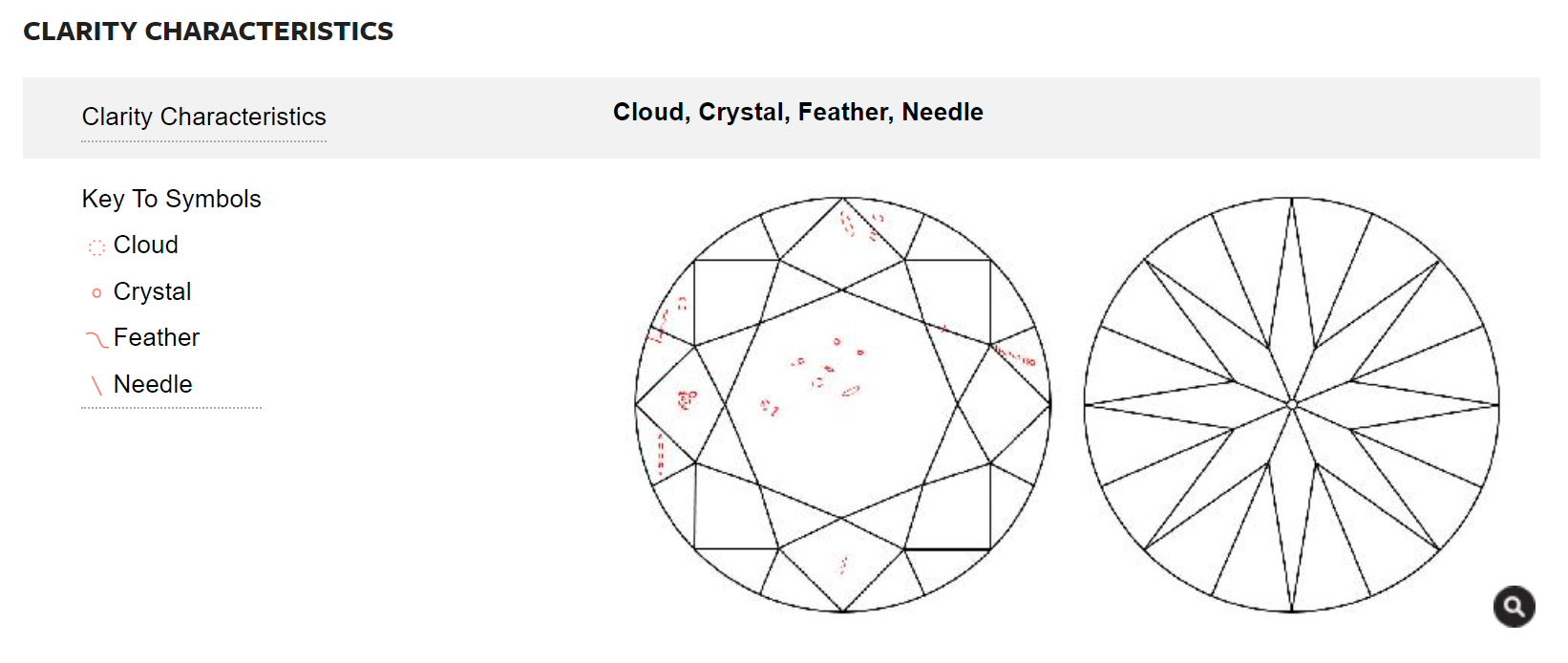
Three sections describe the diamond's clarity: the key to symbols, the comments and the plot.
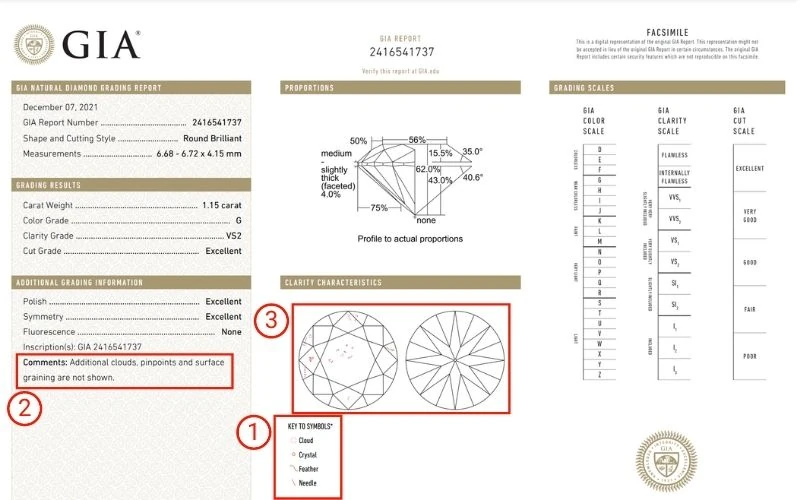
The key to symbols (1 above) lists the inclusions, with the most important first. In our example the main inclusion is a cloud. Each word has a symbol, and the symbols are drawn on the plot (3 above) to show where each inclusion sits and how big it is.
The comments (2 above) describe inclusions the plot cannot show well. Our example says "Additional clouds, pinpoints and surface graining are not shown." Most comments are no cause for worry, but some are deal breakers.
Avoid the comment "Clarity grade is based on clouds that are not shown" on diamonds graded SI1 or lower. It means a cloud set the clarity grade. The diamond may look hazy, and the cloud can reduce its sparkle. Our guide to finding eye clean diamonds shows how to judge inclusions from photos.
5. Proportions: table, depth and angles
The proportions diagram shows the diamond's widths and angles as a percent of its width or in degrees. Our example shows:
- Table 56% and total depth 62.0%
- Crown angle 35.0 degrees and crown height 15.5%
- Pavilion angle 40.6 degrees and pavilion depth 43.0%
- Girdle medium to slightly thick (faceted), 4.0%
- Culet none
It is hard to judge cut quality from these numbers alone, because they work together. StoneAlgo combines them into its cut score for round diamonds. Our guide to depth and table explains the main ranges. To compare two diamonds' proportions side by side, use the diamond comparison tool.
8. The GIA grading scales (GIA diamond grading chart)
The right side of the report shows the full GIA scales for color, clarity and cut. Here they are as tables.
| GIA color grades | Color group |
|---|---|
| D, E, F | Colorless |
| G, H, I, J | Near colorless |
| K, L, M | Faint |
| N to R | Very light |
| S to Z | Light |
| GIA clarity grades | Meaning |
|---|---|
| FL | Flawless |
| IF | Internally flawless |
| VVS1, VVS2 | Very, very slightly included |
| VS1, VS2 | Very slightly included |
| SI1, SI2 | Slightly included |
| I1, I2, I3 | Included |
| GIA cut grades (round diamonds only) |
|---|
| Excellent |
| Very Good |
| Good |
| Fair |
| Poor |
What to avoid on a GIA report
| Red flag | Why it matters |
|---|---|
| The number does not match GIA Report Check or the inscription | The report may belong to a different diamond. |
| "Clarity grade is based on clouds that are not shown" at SI1 or lower | Clouds may make the diamond look hazy and reduce its sparkle. |
| Fair or Poor polish or symmetry | The diamond can look dull or lopsided. |
| Medium or stronger fluorescence on a D to F diamond | We suggest None or Faint fluorescence on colorless grades. |
| A visual carat weight well below the actual weight | The diamond may be cut deep and look smaller than you pay for. |
| No grading report at all | Ask the seller to have the diamond graded by GIA or IGI before you buy. |
GIA reports for lab grown diamonds
In a June 2025 announcement, GIA said it would stop using its D to Z color and clarity grades for lab grown diamonds. Its lab grown reports confirm that the stone is lab grown and describe it as "premium" or "standard." A stone below GIA's minimum quality gets no description. GIA lab grown reports issued earlier with color and clarity grades remain valid.
Learn more in our lab grown vs natural diamonds guide.
Frequently asked questions
Is a GIA certificate the same as a GIA report?
Yes. GIA calls its document a report. Sellers and buyers often call it a certificate or "cert."
How do I verify a GIA certificate?
Enter the report number on GIA Report Check and make sure every detail matches. If the girdle is inscribed, ask a jeweler to show you the number under a loupe.
Is a GIA certificate worth it?
For a diamond of any real value, yes. A GIA report lets you compare diamonds on the same scale, verify what you buy, and get a fair price when you sell.
Does a GIA report show the price of a diamond?
No. A GIA report grades quality only. Use the diamond price calculator or the Diamond Check to estimate a fair price.
Does GIA give a cut grade to oval or princess cut diamonds?
No. GIA gives a cut grade only to standard round brilliant diamonds. For other shapes, judge cut from the proportions, photos and videos.
Check any GIA or IGI diamond for free with our diamond check tool:
