


Updated . Published .
Eye Clean Diamonds: What They Are and How to Find One
An eye clean diamond has no inclusions you can see with the naked eye when you look at it face up from a normal distance. Eye clean is a trade term that GIA does not grade. FL to VS1 diamonds are almost always eye clean, most VS2 diamonds are, and SI1 and SI2 diamonds need a check one by one.
- Eye clean depends on the type, color, size and location of the inclusions, more than on the grade letter.
- Dark inclusions under the table (the large flat facet on top) are the most visible.
- Online photos are magnified many times. A diamond can look included in a photo and clean in person.
- Some inclusions are hard to see and still worth avoiding, such as large clouds and inclusions that reach the surface.
- Large diamonds and step cuts, such as emerald cuts, show inclusions more easily.
Check a diamond for free Search VS2 diamonds
What does eye clean mean?
A diamond is eye clean if you cannot see any inclusions without magnification. Look at it face up, in good light, at a normal viewing distance. If nothing stands out, it is eye clean.
GIA does not use the term. GIA grades clarity at 10x magnification on an 11-grade scale, from flawless (FL) to included (I3). Eye clean is a judgment about what you see without magnification. Two diamonds with the same grade can differ: one can be eye clean and the other not.
The SI2 diamond below has dark inclusions across the stone. It will not be eye clean.

Which clarity grades are eye clean?
This table gives our guidance for GIA or AGS graded diamonds in common sizes. Some other labs grade less strictly, so the same grade there can mean a more included stone.
| Clarity grade | Eye clean? | What to do |
|---|---|---|
| FL, IF, VVS1, VVS2 | Yes | No check needed for clarity |
| VS1 | Yes, almost always | Check very large stones and step cuts |
| VS2 | Usually | Check the main inclusion and a real size photo |
| SI1 | Sometimes | Check every stone with photos, video and the report |
| SI2 | Less often | Check every stone, or see it in person |
| I1, I2, I3 | Rarely | Expect to see inclusions |
See all 11 grades in our diamond clarity chart.
Which inclusions stop a diamond from being eye clean?
Watch for these 5 red flags:
- Dark crystals or other dark inclusions
- A large inclusion under the center of the table
- Many small inclusions under the center of the table
- The report comment "clarity grade is based on clouds that are not shown"
- Feathers or other inclusions that reach the surface
Dark inclusions
Dark inclusions are the worst. They are easier to see than white or clear inclusions. They also block some of the light moving through the diamond, which can make it look less bright.

A large inclusion under the table
The center of the table is the worst place for an inclusion. You see it from every angle. The same inclusion near the edge, under the smaller facets, is much harder to spot and may sit under a prong.

Many inclusions under the table
A diamond with no single large inclusion can still look included. Many small inclusions in the center add up, and together they can dull the sparkle.
"Clarity grade is based on clouds that are not shown"
A cloud is a group of tiny pinpoints. When clouds set the clarity grade, GIA may leave them off the plot and add this comment to the report. You may not see a single inclusion, but large clouds can make the whole diamond look hazy and dull. We suggest you avoid this comment, especially at SI1 and below. Learn more in our guide to reading a GIA report.

Inclusions that reach the surface
Some inclusions are hard to see but still worth avoiding. A feather that reaches the surface can collect dirt. It can also be a weak spot if the diamond takes a hard knock.
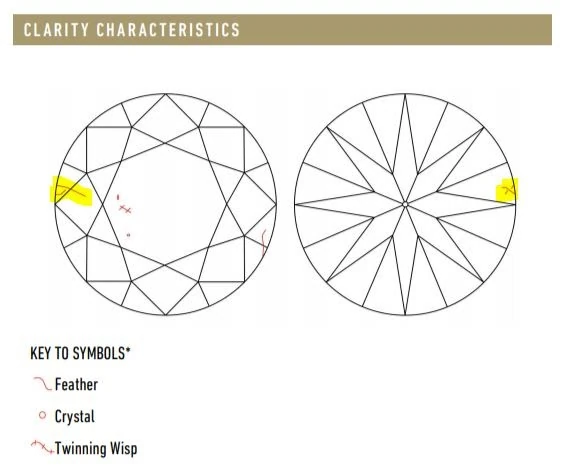
The plot below comes from the hazy diamond above. The top view (left) and the bottom view (right) are mirror images. An inclusion marked at the same edge in both views, as highlighted here, may reach the surface at the girdle.
How to check if a diamond is eye clean
- Read the report first. GIA lists inclusions in order of importance to the grade, so the first one matters most. Check the comments for clouds.
- Find each inclusion in the photo. Note its color and where it sits. Prefer white inclusions near the edge.
- Look at the diamond at real size. Shrink the photo on your screen to about the size of a fingernail. That is closer to what you will see in person.
- Watch the video. Inclusions that hide in one photo can show as the diamond turns.
- Run a free check. Enter the GIA or IGI report number in the StoneAlgo diamond check to see the fair price and more.
- Ask the seller. Many jewelers will look at the stone for you and say if it is eye clean. Treat that as their opinion, and check it yourself.
Are VS2 diamonds eye clean?
Most are, assuming a GIA or AGS report. A few VS2 diamonds are over-graded and show an inclusion. An expert can usually spot these from photos and video, and a jeweler can spot them with a loupe.
A VS2 can also be eye clean and still not be a great example of its grade. The VS2 below is speckled with tiny dark crystals.

More in our VS2 clarity guide.
Are SI1 diamonds eye clean?
Sometimes. In our team's experience, many SI1 diamonds show at least one inclusion, so eye clean SI1 diamonds take work to find.
Price is a clue. SI1 diamonds with the same carat, color and cut can vary a lot in price. The cheapest ones are often cheap because their inclusions show. The eye clean ones often cost close to a VS2. That is why we suggest most online shoppers start at VS2. Read SI1 vs VS2 diamonds for the full comparison.
Are SI2 diamonds eye clean?
Less often. SI2, I1, I2 and I3 diamonds usually show inclusions, and their prices tend to reflect that. A high price at a local store does not prove an SI diamond is eye clean. Check it with the same steps above. For SI2 tips, read our SI2 clarity guide.
Frequently asked questions
What clarity grade is considered eye clean?
FL through VS1 are almost always eye clean. Most VS2 diamonds are too. At SI1 and below, it depends on the stone.
Can I filter a diamond search for eye clean stones?
Some retailers mark diamonds as eye clean after their own check. Treat that as the seller's opinion. On StoneAlgo, search 1 carat G VS2 round diamonds, then check each finalist with the steps above.
Does diamond size affect eye cleanliness?
Yes. In a bigger diamond, inclusions at the same grade can be larger, so they are easier to see. Step cuts with large open tables, such as an emerald cut diamond, also show inclusions more than round diamonds do.
Is an eye clean SI1 as good as a VS2?
Face up, it can look the same. Check that the SI1 has no surface-reaching inclusions and no cloud comment, and compare the two prices with the diamond comparison tool.
