


Updated . Published .
Diamond Cut Score: How It Works
Cut score is StoneAlgo's rating of how well a round diamond is cut for light performance: brilliance, fire and sparkle. It runs on a 10 point scale. The score uses the depth, table, girdle thickness, crown angle and pavilion angle from the diamond's GIA or IGI report. A 9 or higher marks the best cut Excellent diamonds.
- The cut score works on round diamonds, natural or lab grown.
- It splits GIA's broad cut grades into finer steps. A 7 is an average Excellent cut, and a 9 is among the very best.
- In our original study, half of the diamonds we scored had a cut score of 8.4 or higher.
- Better cut scores often cost little or nothing extra, which makes them a free upgrade.
- Check any round diamond's cut score for free in the StoneAlgo Diamond Check.
Check your diamond Search diamonds
How does StoneAlgo's cut score work?
The cut score predicts how much a round diamond will sparkle, on a simple scale up to 10. It helps you find the best cut diamonds and avoid duds. The score takes a round diamond's depth %, table %, girdle thickness, pavilion angle, crown angle and other measurements, and it rates how well the diamond will reflect light back to your eye.
You can check the cut score of any GIA or IGI graded round diamond with our diamond check tool. You can also filter by cut score in the StoneAlgo diamond search.
What do cut scores 0 to 10 mean?
Here is a plain guide to our cut scores and how they line up with GIA cut grades:
| Cut score | What it means |
|---|---|
| 10 | Perfect. In practice no diamond gets a 10, because it would need more precise measurements than a grading report gives. |
| 9 | The very best Excellent cut diamonds |
| 8 | Above average for an Excellent cut |
| 7 | Average for an Excellent cut |
| 6 | Below average for Excellent, above average for Very Good |
| 5 | Average for a Very Good cut |
| 4 | Below average for Very Good, above average for Good |
| 3 | Average for a Good cut |
| 2 | Below average for Good, above average for Fair |
| 1 | Average for a Fair cut |
| 0 | Below average for a Fair cut |
How can you see cut quality in a diamond photo?
If you do not have a cut score, use this rule of thumb. A well cut round diamond shows a tight, circular center between dark arrows that point out toward the edge.
The image below compares a diamond with a 6.0 cut score and a wide center to a diamond with a 9.6 cut score, a tight circular center and clearer arrows. How well you can see the arrows depends on the photo, including its angle and lighting.
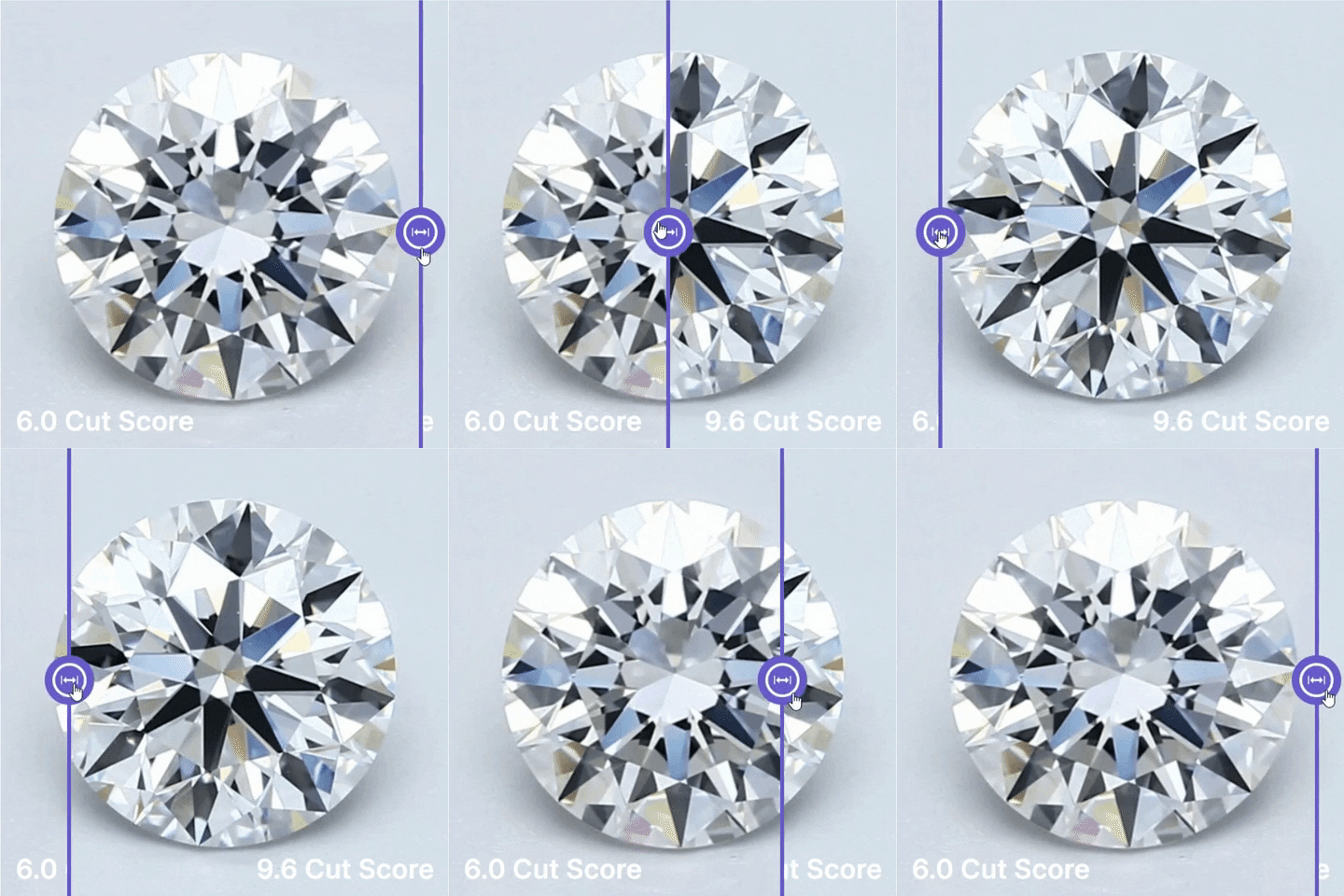
A well cut diamond has a tight, circular center between dark arrows that point out toward the edge.
Read on to learn why we built the cut score, where GIA and AGS cut grades fall short, and how cut quality affects price.
GIA vs AGS cut grades
GIA and the American Gem Society (AGS) each publish tables of the measurements that earn a round diamond an Excellent or Ideal cut. See the GIA cut grade estimation tables and the AGS diamond grading system. The tables show which combinations of table %, pavilion angle and crown angle produce an Excellent or Ideal, Very Good or Good cut. These angles balance each other. For example, a steeper pavilion angle pairs with a shallower crown angle, and the reverse.
Here is an example of GIA's cut grade estimates for round diamonds with a 56% table, across crown angles (top) and pavilion angles (left side). GIA assumes a 3.0% girdle. Depth % follows from the other numbers, so GIA leaves it off these charts.
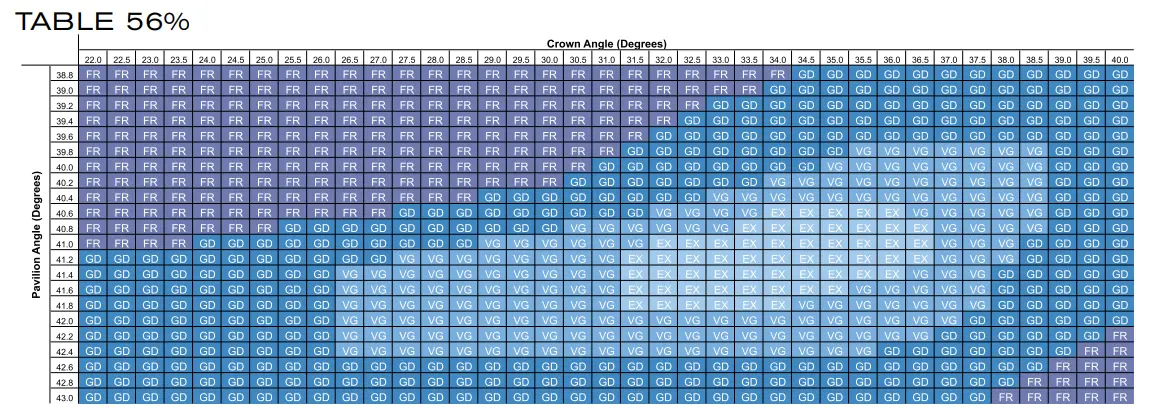
In the end, GIA, AGS and other labs put diamonds into fixed groups such as Ideal or Excellent, Very Good, Good, Fair and Poor. So why treat the worst Excellent cut and the best Very Good cut as different when they are nearly the same?
As the table above shows, a single degree of pavilion angle can move a diamond from Excellent to Very Good. And why treat the worst Excellent cut the same as the best? If the worst Excellent is nearly a Very Good, and the best is far from that line, it makes sense to prefer the better one.
GIA and AGS also disagree on the exact limits of their top grades, because each lab sets its own rules. A single word for cut quality was too coarse for picky diamond buyers like us. We wanted something finer, so we started our own research.
AGS Laboratories closed at the end of 2022 and merged into GIA. GIA now offers AGS Ideal reports for diamonds that meet the AGS standard.
The most important angles for diamond cut quality
No single cut is perfect. There are many "local maximums" on the cut quality scale, and they depend on several angles and measurements that balance each other. The key measurements are table %, pavilion angle, crown angle, girdle thickness and depth % (which follows from the others). Most cut quality charts leave out girdle thickness. That is a major gap, because girdle thickness changes the pavilion angle needed to send light back out through the top of the diamond.
Our guide to depth and table explains the two numbers most buyers see first.
Diamond cut charts
AGS Ideal cut diamonds (AGS 0 cut grade) meet stricter limits than GIA Excellent cut diamonds. The two also differ, so some AGS 0 diamonds are not GIA Excellent, and the reverse. One of our first steps was to study every AGS cut grid to see how AGS judged cut quality from two dimensional data.
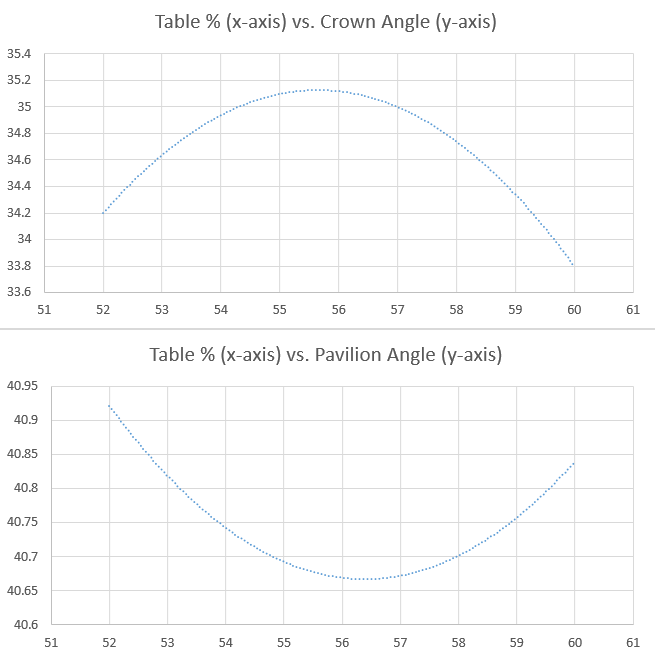
AGS published heat maps by table % that show the best crown and pavilion angles for its grades from AGS 0 to 10 (AGS 0 is the best), with the girdle fixed at 3.5%. Below, the sweet spot for crown and pavilion angles (the red AGS 0 zone) moves and shrinks a lot when the table changes from 57% to 60%. Our scoring system had to adjust to different measurements in the same way.


The charts below show how the best crown angle and pavilion angle shift at different table percentages.
Old mathematical models
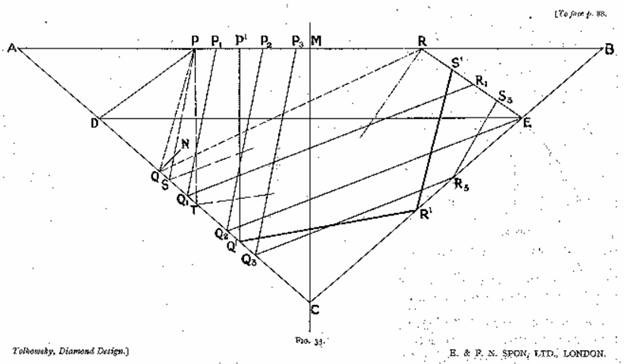
AGS has done great work, but we needed our own model. It had to handle different girdle thicknesses and score over a million diamonds, to find the best and worst of the GIA Excellent and AGS Ideal cut diamonds. We found our footing in a 1919 book on the mathematics of diamond design by Marcel Tolkowsky, Diamond Design. Tolkowsky wrote that, although diamond cutting was thousands of years old, no one had worked out the best shape for the gem by mathematics, and his book set out to calculate it.
Tolkowsky studied the optics of light performance and how it relates to a gem's angles and overall shape. He described reflection (light bouncing off the diamond), refraction (light that enters the diamond and bends) and dispersion (white light splitting into rainbow colors, also called "fire"). His framework is the base of our own math, and we are grateful for it.
The StoneAlgo cut quality score
After studying many technical and general sources, we built our own formula. It uses all the relevant angles and measurements, including girdle thickness, to estimate a diamond's cut quality. The model gives a maximum of 10 points for a "perfect" diamond. It takes points away the further a diamond's shape falls from its nearest perfect version.
A round diamond has many ideal shapes, because table %, pavilion angle, girdle and crown angle can balance each other in different ways. Our scoring system accounts for this. We believe it is the best two dimensional cut analysis tool available. It gives a quick read on cut quality and light performance without 3D light performance imaging.
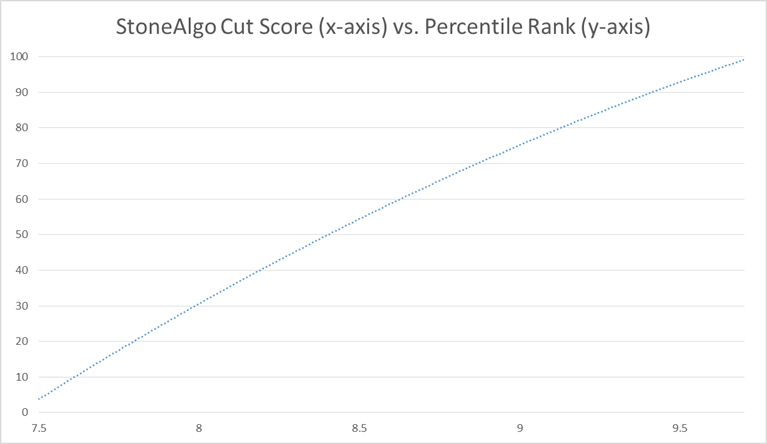
In our original study, in November 2018, we scored more than 1.1 million diamonds and ranked them by cut score:
| Share of diamonds scored | Cut score |
|---|---|
| Top 1% | 9.7 or higher |
| Top 10% | 9.4 or higher |
| Top 25% | 9.0 or higher |
| Top 50% | 8.4 or higher |
We suggest you look for diamonds in the top 50% of GIA Excellent cut diamonds. They rarely cost much more, and they give better light performance. When we shopped for a diamond ourselves, it felt like a free upgrade.
How does cut quality affect diamond prices?
Given the choice between the best and the worst GIA Excellent cut diamond, with everything else equal, nearly everyone would pick the best. So it makes sense to value the best cut diamond more than the worst.
The market does not always price that difference, which creates buying chances for the best cut diamonds. Sometimes the market does discount diamonds with lower cut quality, even when GIA grades them Excellent. Then a lower cut score diamond can be a smart buy, as long as it still looks good to you. The lowest GIA Excellent cuts are still well made and should look great to the eye. It comes down to what you want and what the diamond costs.
To compare two round diamonds' cut scores and prices side by side, use the diamond comparison tool. To check whether a price is fair, use the Diamond Price Calculator.
A final note on finding diamonds
Like any math model built from limited data, the StoneAlgo cut score is not an exact measure of a diamond's beauty. Our data is two dimensional, and a diamond is a 3D object. We have to assume the angles and widths are the same all the way around the diamond, and often they are not.
Still, the model does its job well and should track light performance closely. We studied light performance images for a large set of diamonds to confirm this. The cut score is a tool, and it does not replace your own eyes. Never buy a diamond sight unseen, which is why StoneAlgo shows diamonds with real HD images, and light performance images when they exist. For more on shopping for round diamonds, read our round cut diamond guide and our guide to diamond cut.
Frequently asked questions
What is a good diamond cut score?
A score of 8.4 or higher puts a diamond in the top half of the diamonds in our original study. A 9 or higher marks the very best Excellent cut diamonds.
Does the cut score work for oval or princess cut diamonds?
No. The cut score works only on round diamonds, because our model is built on the geometry of the round brilliant. For other shapes, judge cut from photos, videos and the proportions on the GIA report.
Is the cut score the same as the GIA cut grade?
No. GIA gives each round diamond one of five cut grades, from Excellent to Poor. The cut score splits those grades into finer steps, so you can tell a top Excellent cut from a borderline one.
How do I find a diamond's cut score?
Enter its GIA or IGI report number in the Diamond Check, or filter by cut score in the diamond search.
