


Updated . Published .
Diamond Color Chart: The GIA D to Z Color Scale Explained
Diamond color is graded on the GIA scale from D to Z. D is the highest color grade and means colorless. Each letter after D shows a little more yellow or brown tint, down to Z. Near colorless grades G to J look white face up in most rings and cost less than colorless D to F.
- D, E and F are colorless. G, H, I and J are near colorless. K, L and M show a faint tint.
- In our experience, most people cannot tell a D from a G unless the two sit side by side in controlled light.
- A warm tint usually starts to show around J or K, so we suggest K as the lowest grade for an engagement ring.
- Diamond size, shape, fluorescence and the setting metal all change how much color you see.
- Compare the price of two color grades in the Diamond Price Calculator before you decide.
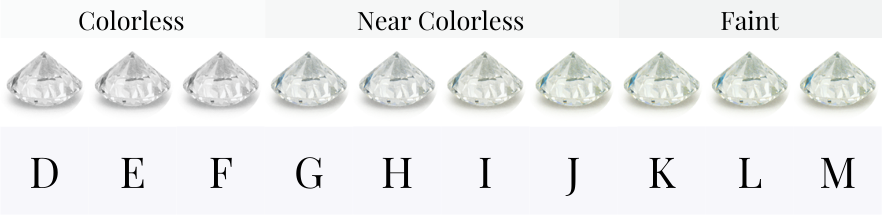
What is the diamond color scale?
The GIA color scale runs from D, which is colorless, to Z, which is light yellow or brown. GIA grades color by comparing each diamond with stones of known color under controlled light and viewing conditions. GIA started its scale at D so that it had no ties to older systems, which used letters such as A, B and C or numbers.
Here is the diamond color chart, with what each grade looks like and our advice.
| Color grade | GIA group | What you see | Our advice |
|---|---|---|---|
| D | Colorless | Icy white with no color. The highest grade. | Buy it if you want the top grade and the budget allows. |
| E | Colorless | No color visible face up | Nearly the same look as D for less money. |
| F | Colorless | No color visible face up | The lowest colorless grade and good value within it. |
| G | Near colorless | Looks white face up. A trace of color only side by side. | A safe choice for platinum and white gold. |
| H | Near colorless | Looks white face up | A popular balance of look and price. |
| I | Near colorless | Looks white face up in most settings | Strong value, especially in round diamonds. |
| J | Near colorless | A slight warm tint can show, more in large diamonds | The best value in near colorless. |
| K | Faint | Can face up white. Shows color from the side. | The lowest grade we suggest for a ring. |
| L to M | Faint | A tint many people can see | Below our suggested range. Yellow or rose gold hides some tint. |
| N to Z | Very light to light | A clear yellow or brown tint | Below our suggested range. |
What is the highest color of diamond?
D is the highest color grade a diamond can get on the GIA scale. A D color diamond is colorless and is the rarest and most expensive grade. Diamonds with strong natural color, such as pink, blue or deep yellow, are graded on a separate GIA scale for fancy colored diamonds.
Diamond color grades D to K
Each grade has its own guide with photos, price notes and buying tips.
D color diamonds
D color diamonds look perfectly white with no tint. D is the top grade from GIA. A D color diamond gains nothing from fluorescence, because it is already colorless.
E color diamonds
GIA groups E with D and F as colorless. An E color diamond looks totally white, but it has a trace of color that separates it from a D under lab conditions.
F color diamonds
F is the lowest colorless grade. To the naked eye, an F color diamond is nearly impossible to tell apart from D and E.
G color diamonds
G is the highest near colorless grade. Most people cannot tell a G color diamond from a colorless one. Many jewelers suggest None, Faint or Medium fluorescence with a G color diamond.
H color diamonds
H color diamonds sit in the sweet spot between looks and value, which makes them one of the most popular choices. Many jewelers suggest None, Faint or Medium fluorescence with an H color diamond.
I color diamonds
I color diamonds give great value and still look white to the naked eye in most settings. Faint or Medium fluorescence can help an I color diamond look a little whiter, and it can lower the price.
J color diamonds
J is the best value in the near colorless range. A J color diamond still looks white face up in most settings. Some fluorescence can help it look whiter.
K color diamonds
K is the first faint grade and a favorite of buyers who want to stretch their budget. A K color diamond can face up white, but it usually shows color from the side.
Which diamond color grade should I choose?
For most buyers, G to I is the best balance of looks and price. Use this table as a starting point:
| Your ring | Color grades to consider |
|---|---|
| Round diamond in platinum or white gold | G to I |
| Round diamond in yellow or rose gold | I to K. Warm metal hides a faint tint. |
| Oval, pear, cushion or radiant shape | One grade higher than for a round. These shapes can show color more. |
| A large diamond (2 carats or more) | One grade higher. Color is easier to see in a bigger diamond. |
| You want no compromise | D to F |
Always look at photos or videos of the actual diamond. Search by color grade in the StoneAlgo diamond search, and compare up to 4 diamonds side by side with the diamond comparison tool.
How does color affect diamond price?
Each step up in color usually raises the price for the same carat, clarity and cut. To see the gap for your size, price the same diamond in two color grades with the Diamond Price Calculator. Then decide whether the extra whiteness is worth the money to you.
Frequently asked questions
What is the best color grade for a diamond?
D is the highest grade. For value, most buyers choose G to I, which look white face up and cost less than D to F.
Can you see the difference between G and H color?
Most people cannot when the diamond is face up in a ring. Side by side under bright, even light, a trained eye may see that the H is slightly warmer.
Is J color too yellow?
Usually not. A J color round diamond looks white face up in most settings. In a large or elongated diamond, or in a platinum setting, a slight warm tint can show. See our J color guide.
What does near colorless mean?
Near colorless is GIA's name for grades G, H, I and J. These diamonds show only a trace of color, which most people cannot see once the diamond is set.
What color grade is a lab grown diamond?
Labs such as IGI grade lab grown diamonds on the same D to Z scale. GIA now describes lab grown diamonds as "premium" or "standard" in place of a D to Z grade.
