


Updated . Published .
Lab Grown vs Natural Diamonds: Price and Value Compared
Lab grown and natural diamonds are the same material, with the same hardness and sparkle. The big difference is price. In November 2026 a 1 carat lab grown diamond averaged $559 on StoneAlgo, and a natural one averaged $3,828. Natural diamonds keep more resale value. Only lab testing or a grading report can tell them apart.
- Lab grown diamonds cost 85% less than natural at 1 carat and 94% less at 2 carats (StoneAlgo price index, November 2026).
- A lab grown diamond is a real diamond. Sellers must say clearly that it is lab grown.
- You cannot tell them apart by eye. Check the grading report and the girdle inscription.
- Natural diamonds resell for more. Lab grown diamonds resell for little, because new ones have become much cheaper.
- Compare live prices on the natural diamond prices and lab grown diamond prices pages.
What is the difference between lab grown and natural diamonds?
| Natural diamond | Lab grown diamond | |
|---|---|---|
| Origin | Formed deep in the earth. Most are billions of years old. | Grown in a lab in weeks or months |
| Material | Carbon in a diamond crystal | The same |
| Hardness and durability | One of the hardest materials on earth | The same |
| Look | Graded on color, clarity and cut | The same range of looks |
| Average 1 carat price (Nov 2026) | $3,828 | $559 |
| Resale value | Holds more of its value | Low |
| How to identify | Grading report and lab testing | Grading report, lab testing and often a "lab grown" inscription |
Tip: Use the StoneAlgo diamond search to compare lab grown and natural diamonds from top online jewelers in one place.
Lab grown vs natural diamond price difference
Price is the main reason people choose lab grown. In November 2026 the StoneAlgo Diamond Price Index (updated November 12, 2026) gave these averages. They cover all shapes with color D to K and clarity FL to SI2.
| Carat weight | Natural | Lab grown | Lab grown costs less by |
|---|---|---|---|
| 0.5 carat | $1,080 | $401 | 63% |
| 1 carat | $3,828 | $559 | 85% |
| 1.5 carats | $8,270 | $755 | 91% |
| 2 carats | $17,358 | $1,054 | 94% |
| 2.5 carats | $28,155 | $1,242 | 96% |
| 3 carats | $41,494 | $1,625 | 96% |
| 4 carats | $74,857 | $2,171 | 97% |
| 5 carats | $116,594 | $2,170 | 98% |
The gap grows with size. A natural diamond's price climbs steeply with carat weight, while lab grown prices rise slowly. Prices change every day. For today's numbers, see the 1 carat natural diamond prices and the 1 carat lab grown diamond prices, or price a specific diamond in the Diamond Price Calculator.
Are lab grown diamonds real diamonds?
Yes. A lab grown diamond (also called a man made or lab created diamond) has the same chemical makeup and crystal structure as a natural diamond. In its 2018 update to the Jewelry Guides, the U.S. Federal Trade Commission removed the word "natural" from its definition of a diamond. Sellers must still say clearly that a diamond is lab grown, with words such as "laboratory-grown" or "laboratory-created."
When you talk to a jeweler, say which one you want. Both are real diamonds, so "real diamond" alone does not tell you which one you are getting.
How are lab grown diamonds made?
Labs grow diamonds in one of two ways:
- HPHT (high pressure, high temperature) puts carbon under the heat and pressure found deep in the earth, so it crystallizes as diamond.
- CVD (chemical vapor deposition) grows a diamond layer by layer on a small diamond "seed" from a carbon-rich gas.
Either way, the carbon atoms build on the diamond crystal and follow its structure. That is why these diamonds are described as grown.
Natural diamonds formed from carbon under great heat and pressure deep in the earth. Volcanic eruptions carried them toward the surface. Miners dig most of them from the ground, and some are found near the surface or in riverbeds. Cutters then cut and polish the rough into the gems you see in stores.
How can you tell a lab grown diamond from a natural one?
You cannot tell them apart by eye. A natural and a lab grown diamond with the same grades look the same.
The reliable way is the grading report. Labs such as GIA and IGI test every diamond and state on the report whether it is lab grown. Enter the report number in the StoneAlgo Diamond Check to see the details. Many lab grown diamonds also carry a laser inscription on the girdle that says they are lab grown.
Labs and jewelers use screening machines like the one below. They look for growth features and trace elements that differ between natural and lab grown diamonds.
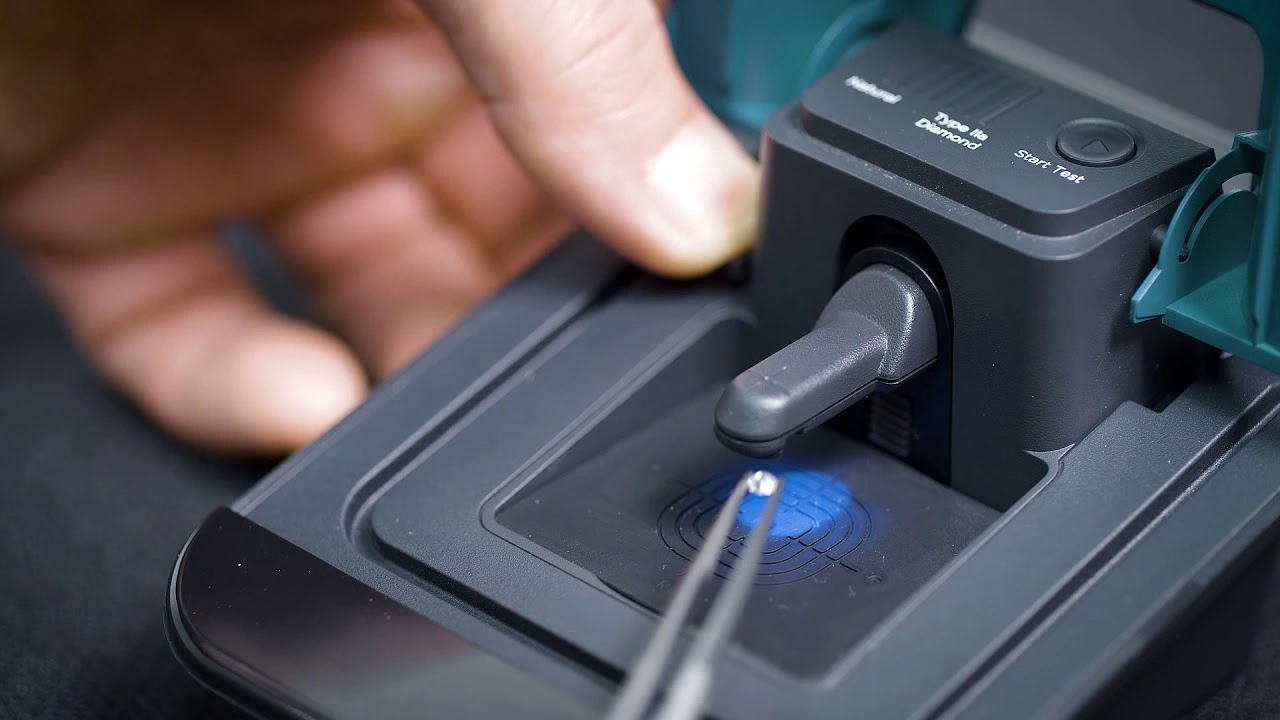
If someone offers you a diamond without a grading report, ask for it to be graded before you buy. Our guide to reading a GIA report explains what to look for.
Do lab grown diamonds hold their value?
Natural diamonds keep more of their value over time, so they are the better choice if resale matters to you. Lab grown prices have fallen a lot over the years as production grew. When new lab grown diamonds cost so little, a used one resells for a small part of what the buyer paid.
Natural diamonds resell below retail too. When we tried to sell a natural diamond on 12 websites, the offers were 39% to 60% of its retail price. Read where to sell a diamond online for the full test.
Are lab grown diamonds flawless?
No. Lab grown diamonds come in a range of colors, clarities and cuts, just like natural ones. They can have inclusions, so some are near flawless and others are heavily included.
IGI grades lab grown diamonds on the same color and clarity scales as natural diamonds. In June 2025 GIA announced that it would stop using those scales for lab grown diamonds. GIA lab grown reports describe a stone as "premium" or "standard."
StoneAlgo's cut score works for round lab grown diamonds, and our visual carat weight works for all 10 shapes we carry.
Lab grown vs natural diamonds: environment and ethics
Both have tradeoffs. The choice depends on your values.
- Mining: Diamond mining moves large amounts of earth and can harm land, water and wildlife. Mining can also raise labor and human rights concerns. Since 2003, the Kimberley Process has required member countries to certify that rough diamonds they trade are conflict free. Mining also supports jobs and businesses in many communities.
- Lab growing: It needs no mine, but growing a diamond takes a lot of energy. Its footprint depends on how that energy is made. Labor conditions at growers vary too.
Another option is a pre-owned natural diamond. Our guide to recycled diamonds vs new diamonds covers it.
Lab grown or natural: which should you choose?
| Choose lab grown if you | Choose natural if you |
|---|---|
| Want the biggest diamond for your budget | Want a diamond that keeps more resale value |
| Do not plan to resell | Value a diamond that formed in the earth |
| Want to avoid mining | Want to support mining communities |
| Want a higher color and clarity for the money | Plan to pass it down or trade it in later |
Whichever you pick, compare the actual diamonds. Our guide to diamond carat size shows how big each size looks, and the diamond search shows both types side by side.
Frequently asked questions
Are lab grown diamonds real diamonds?
Yes. They have the same chemistry, crystal structure and hardness as natural diamonds. The FTC treats them as diamonds, and sellers must disclose that they are lab grown.
How much cheaper are lab grown diamonds than natural?
In November 2026, about 85% cheaper at 1 carat and 94% cheaper at 2 carats, based on StoneAlgo's average prices. The gap is smaller for small diamonds and larger for big ones.
Can a jeweler tell if a diamond is lab grown?
Not by eye. A jeweler needs a screening machine or a lab report. Check the grading report and look for a "lab grown" inscription on the girdle.
Do lab grown diamonds hold their value?
Not well. Lab grown prices have dropped as production grew, so resale offers are low. Natural diamonds hold more of their value.
Is a lab grown diamond worth it?
If you want the most size and quality for your money and do not plan to resell, yes. If resale value or natural origin matters to you, choose natural.
