


Updated . Published .
Diamond Depth and Table: What the Percentages Mean
Table percentage is the width of a diamond's top facet divided by its average diameter. Depth percentage is its height from table to culet divided by that diameter. Both shape how big a diamond looks and how much light it returns. For an Excellent round, GIA allows a table of 52% to 62% and a depth of 57.5% to 63%.
- Both percentages use the diamond's average girdle diameter (GIA).
- A shallower diamond spreads its weight across a wider top, so it looks larger for its carat weight.
- Too shallow or too deep, and a round returns less light. GIA also lowers the grade of a diamond with too much weight for its diameter.
- Inside GIA's limits, the crown and pavilion angles decide the cut grade, so check them or a cut score.
- Fancy shapes have no GIA cut grade, so use the typical ranges in each shape guide.
🛡️ Check your diamond 💎 Search diamonds
What are diamond table and depth percentage?
GIA measures both against the average girdle diameter: the average of the diamond's smallest and largest width at the girdle (GIA).
- Table percentage: the width of the table, the large flat facet on top, divided by the average diameter. GIA reports it to the nearest whole percent.
- Depth percentage (total depth): the height from the table to the culet, the point at the bottom, divided by the average diameter. GIA reports it to the nearest 0.1%.
For example, a round diamond that is 6.4 mm wide and 3.9 mm deep has a depth of about 61%.

How do depth and table change how big a diamond looks?
Carat is weight, and you see a set diamond from the top. If two diamonds weigh the same, the shallower one spreads that weight across a wider top, so it looks larger face up. The deeper one hides more of its weight below the girdle.
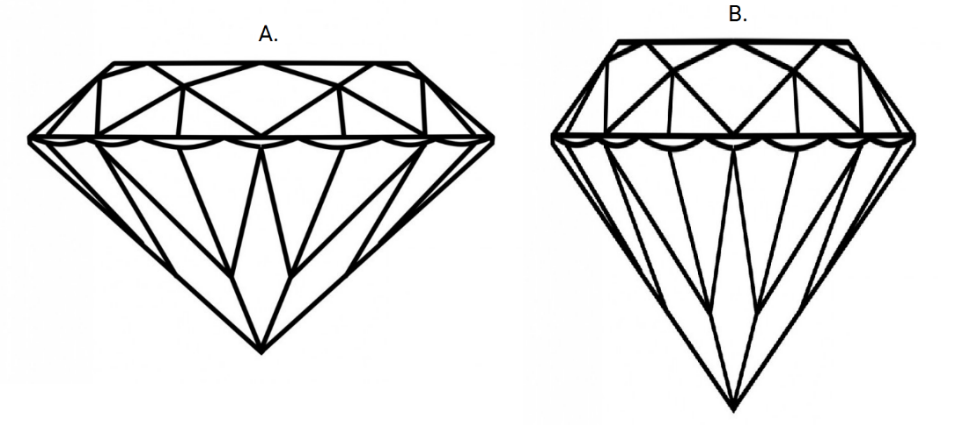
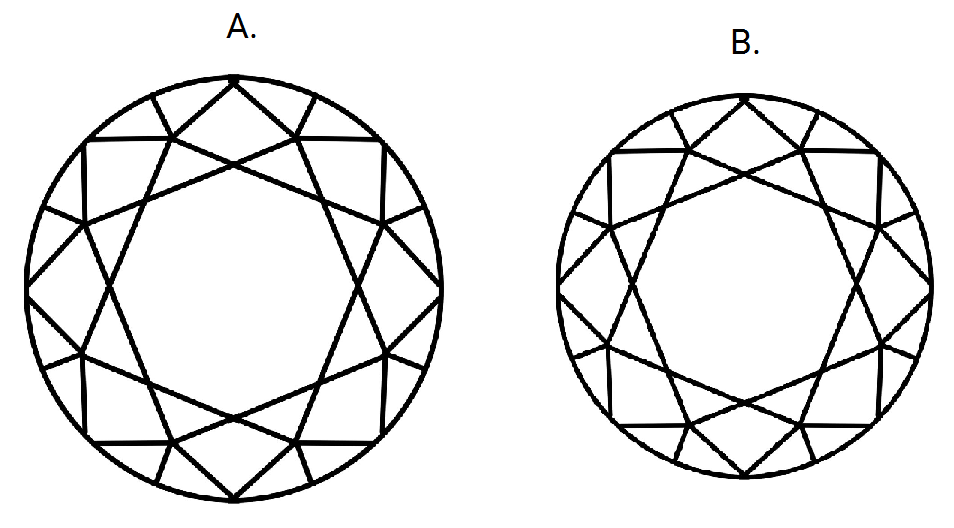
Diamonds A and B weigh the same. Face up, A looks larger.
Wider helps only up to a point. Diamond C below is shallower still and looks larger again, but a round that is too shallow returns less light. GIA's cut grade also judges weight ratio: a diamond can carry too much weight for its diameter, which means you pay for size you cannot see.
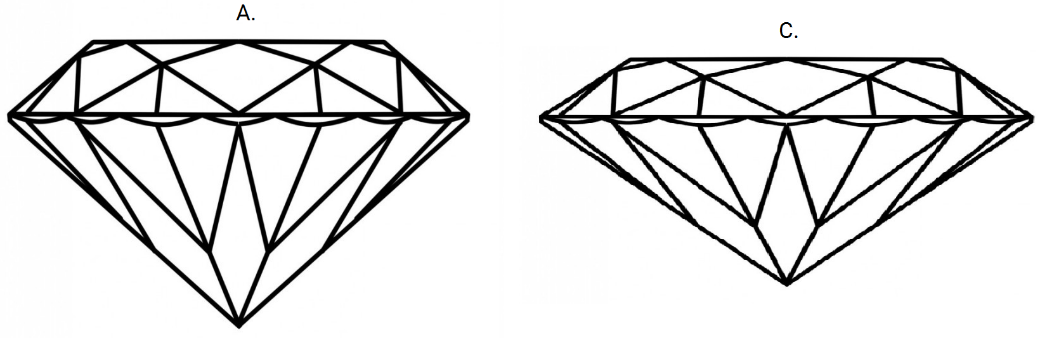
StoneAlgo's visual carat turns this into one number: how large a diamond looks face up, stated as the weight of an average diamond of that size. A 1 carat diamond with a visual carat of 1.05 looks like an average 1.05 carat diamond.
How do depth and table affect sparkle?
Light enters through the top, reflects off the pavilion facets underneath and comes back out through the crown. The table, crown angle and pavilion angle decide how much light returns and how it splits into brightness, fire and scintillation. GIA notes that table size has a big effect on face-up appearance when combined with certain crown and pavilion angles, and that steep pavilion angles can produce dark areas under the table (GIA).
Large tables leave less room for error. GIA's guide to its cut grading system notes that diamonds with large tables have only a few proportion combinations that reach the Excellent grade. Our diamond cut guide explains how GIA builds the full cut grade.
What is the ideal depth and table for a round diamond?
There is no single ideal number. GIA grades a round brilliant on the combination of its table, crown angle, pavilion angle and other parameters. Its published limits show the widest range each parameter can have and still reach a grade (GIA, Estimating a Cut Grade):
| GIA cut grade | Table % | Total depth % | Crown angle | Pavilion angle |
|---|---|---|---|---|
| Excellent | 52% to 62% | 57.5% to 63.0% | 31.5° to 36.5° | 40.6° to 41.8° |
| Very Good | 50% to 66% | 56.0% to 64.5% | 26.5° to 38.5° | 39.8° to 42.4° |
| Good | 47% to 69% | 53.0% to 66.5% | 22.0° to 40.0° | 38.8° to 43.0° |
| Fair | 44% to 72% | 51.9% to 70.9% | 20.0° to 41.5° | 37.4° to 44.0° |
A diamond inside every Excellent limit can still get a lower grade when its parameters interact badly, above all the table, crown angle and pavilion angle. In one GIA example, a round with a 53% table and Excellent angles got Very Good, because its 64.2% depth, thick girdle and medium culet gave it too much weight for its diameter.
For a specific round, StoneAlgo's cut score rates the full set of proportions on a 10 point scale. Our round cut diamond guide covers the rest of what to check. You can filter by table % and depth % in diamond search.
What depth and table should a fancy shape have?
GIA gives an overall cut grade only to standard round brilliants (GIA). Fancy shapes such as oval, cushion and emerald get polish and symmetry grades but no cut grade, so typical table and depth ranges come from the market for each shape. Many fancy shapes run deeper than rounds. Our shape guides list the ranges for each:
- Oval cut diamond guide
- Cushion cut diamond guide
- Emerald cut diamond guide
- Princess cut diamond guide
For any shape, compare the face-up size in millimeters as well as the carat weight, and look at photos or video for dark areas. To see two diamonds side by side, use the diamond comparison tool.
Frequently asked questions
What is a good depth percentage for a round diamond?
GIA's Excellent grade allows a total depth of 57.5% to 63.0% for a round brilliant. Within that range, the crown and pavilion angles decide the grade. Fancy shapes vary by shape.
What is a good table percentage for a round diamond?
GIA's Excellent grade allows a table of 52% to 62%. Larger tables reach Excellent with fewer combinations of crown and pavilion angles.
Does a lower depth make a diamond look bigger?
Yes, up to a point. A shallower diamond spreads its weight across a wider top, so it looks larger for its carat weight. Too shallow, and it returns less light.
Why does depth percentage matter?
Depth shows how a diamond's weight is spread. Too deep, and weight sits where you cannot see it. Too shallow, and light leaks out of the bottom. GIA counts weight ratio as part of the cut grade.
