


Updated . Published .
Cushion Cut Diamond Size Chart: Carat to MM
A 1 carat cushion cut diamond averages about 5.8 mm across its length and width. A 2 carat cushion averages 7.2 mm and a 3 carat cushion 8.3 mm. Carat is a weight, so the cut proportions change how big a cushion looks for its weight. Use the chart below as the typical size for each weight.
- Sizes at a glance: 0.5 carat 4.6 mm, 1 carat 5.8 mm, 2 carats 7.2 mm, 3 carats 8.3 mm.
- Size grows slower than weight: going from 1 to 2 carats doubles the weight and adds 1.4 mm to the average size.
- Compared with round: a cushion measures a little less across than a round diamond of the same weight (5.8 mm against 6.4 mm at 1 carat).
- Check the report: a deep cut hides weight below the girdle, so compare the measurements on the grading report before you buy.
 Round
 Cushion
 Emerald
 Oval
 Princess
 Pear
 Radiant
 Asscher
 Heart
 Marquise
Cushion cut diamond size chart: carat to mm
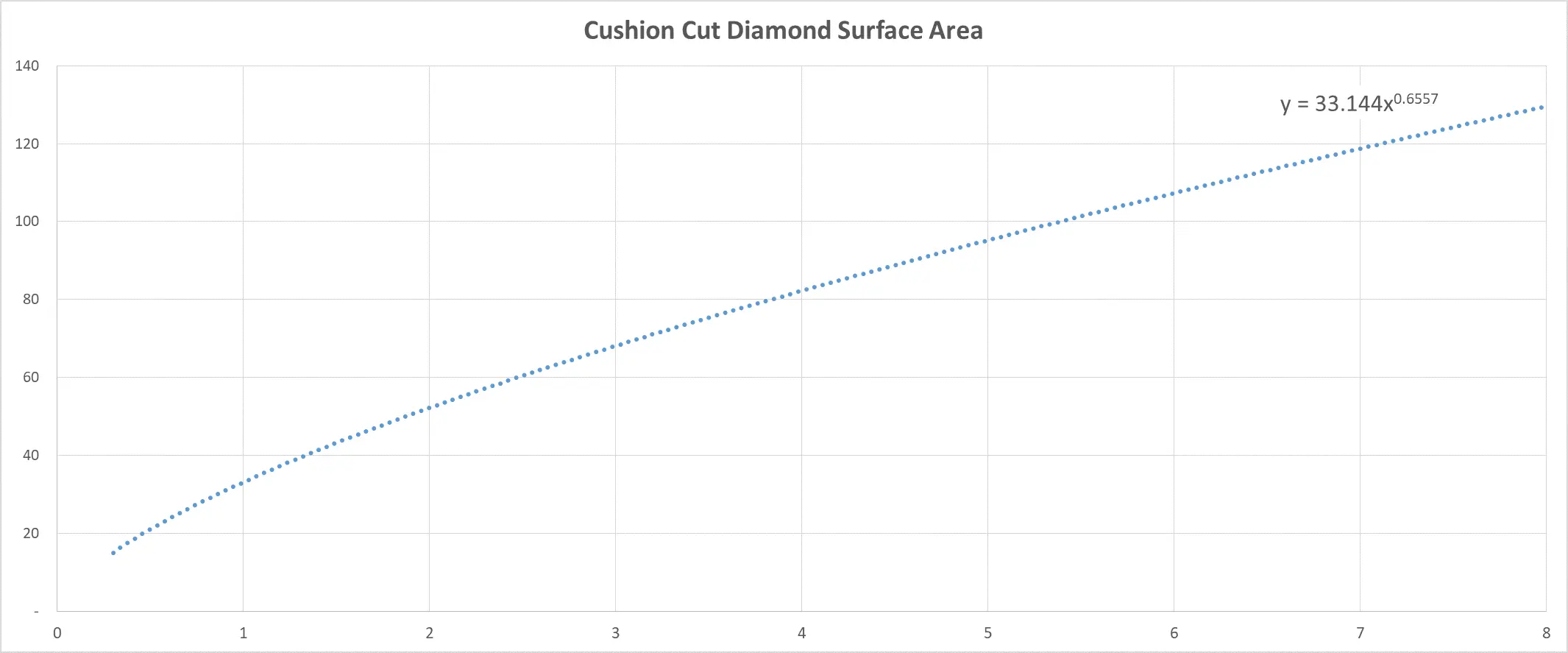
Cushion cut diamonds are square or rectangular with rounded corners, like a pillow. The chart below shows the typical size of a cushion from 0.3 to 5 carats. Average size is the average of the length and the width, in millimeters. Face-up area is the size of the top of the diamond as you see it from above, in square millimeters.
| Carat weight | Average size (mm) | Face-up area estimate (sq mm) |
|---|---|---|
| 0.3 carat | 3.9 | 15.1 |
| 0.4 carat | 4.3 | 18.2 |
| 0.5 carat | 4.6 | 21.0 |
| 0.6 carat | 4.9 | 23.7 |
| 0.7 carat | 5.1 | 26.2 |
| 0.8 carat | 5.4 | 28.6 |
| 0.9 carat | 5.6 | 30.9 |
| 1 carat | 5.8 | 33.1 |
| 1.5 carats | 6.6 | 43.2 |
| 2 carats | 7.2 | 52.2 |
| 2.5 carats | 7.8 | 60.4 |
| 3 carats | 8.3 | 68.1 |
| 3.5 carats | 8.7 | 75.4 |
| 4 carats | 9.1 | 82.3 |
| 5 carats | 9.8 | 95.2 |
How we got these numbers: StoneAlgo averaged the measurements of cushion cut diamond listings at online retailers for each carat weight, then fit a smooth curve to the averages. Each figure is a typical value. A single diamond can measure more or less, depending on its cut.
Every size from 0.3 to 5 carats, in 0.1 carat steps
| Carat weight | Average size (mm) | Face-up area estimate (sq mm) |
|---|---|---|
| 0.3 carat | 3.88 | 15.05 |
| 0.4 carat | 4.26 | 18.18 |
| 0.5 carat | 4.59 | 21.04 |
| 0.6 carat | 4.87 | 23.71 |
| 0.7 carat | 5.12 | 26.23 |
| 0.8 carat | 5.35 | 28.63 |
| 0.9 carat | 5.56 | 30.93 |
| 1 carat | 5.76 | 33.14 |
| 1.1 carats | 5.94 | 35.28 |
| 1.2 carats | 6.11 | 37.35 |
| 1.3 carats | 6.27 | 39.37 |
| 1.4 carats | 6.43 | 41.33 |
| 1.5 carats | 6.58 | 43.24 |
| 1.6 carats | 6.72 | 45.11 |
| 1.7 carats | 6.85 | 46.94 |
| 1.8 carats | 6.98 | 48.73 |
| 1.9 carats | 7.11 | 50.49 |
| 2 carats | 7.23 | 52.21 |
| 2.1 carats | 7.34 | 53.91 |
| 2.2 carats | 7.46 | 55.58 |
| 2.3 carats | 7.56 | 57.23 |
| 2.4 carats | 7.67 | 58.84 |
| 2.5 carats | 7.77 | 60.44 |
| 2.6 carats | 7.88 | 62.02 |
| 2.7 carats | 7.97 | 63.57 |
| 2.8 carats | 8.07 | 65.10 |
| 2.9 carats | 8.16 | 66.62 |
| 3 carats | 8.25 | 68.12 |
| 3.1 carats | 8.34 | 69.60 |
| 3.2 carats | 8.43 | 71.06 |
| 3.3 carats | 8.52 | 72.51 |
| 3.4 carats | 8.60 | 73.94 |
| 3.5 carats | 8.68 | 75.36 |
| 3.6 carats | 8.76 | 76.77 |
| 3.7 carats | 8.84 | 78.16 |
| 3.8 carats | 8.92 | 79.54 |
| 3.9 carats | 8.99 | 80.90 |
| 4 carats | 9.07 | 82.26 |
| 4.1 carats | 9.14 | 83.60 |
| 4.2 carats | 9.22 | 84.93 |
| 4.3 carats | 9.29 | 86.25 |
| 4.4 carats | 9.36 | 87.56 |
| 4.5 carats | 9.43 | 88.86 |
| 4.6 carats | 9.49 | 90.15 |
| 4.7 carats | 9.56 | 91.43 |
| 4.8 carats | 9.63 | 92.70 |
| 4.9 carats | 9.69 | 93.97 |
| 5 carats | 9.76 | 95.22 |
The face-up area is an estimate from a simple geometric formula for each shape. Use it to compare sizes within this chart. To compare different shapes, use the sizes in mm. See all ten shapes side by side in our diamond size chart.
How big is a 1 carat cushion cut diamond?
In our chart, a 1 carat cushion averages 5.8 mm across its length and width. Cushions come in square and elongated outlines. An elongated cushion of the same weight is longer than the average size and narrower than it.
To see real examples, open the 1 carat cushion cut diamond price page. It lists diamonds for sale, and you can sort them by visual carat to find the ones that look biggest for their weight.
Why two cushion cut diamonds of the same carat can look different sizes
Carat is a unit of weight. GIA defines one metric carat as 200 milligrams. A diamond cut with a deep body keeps more of its weight below the girdle, where you cannot see it from above. GIA's cut research gives the example of a 1 carat round that measures only 5.7 mm across, against roughly 6.5 to 6.6 mm for a typical one. The same effect applies to every shape.
Our cushion cut diamond guide explains the proportions and shapes to look for in a cushion. To see how depth changes the look of a diamond, read what to know about depth and table. StoneAlgo also shows a visual carat weight for each diamond. It compares the diamond's face-up area with the average for its shape and weight, so you can spot the diamonds that look bigger than their weight.
Find a cushion cut diamond that looks its size
- Browse cushion cut diamonds on StoneAlgo, from popular carat, color and clarity searches to the newest listings.
- Check today's 1 carat cushion cut diamond prices and sort the listings by visual carat.
- Put two diamonds side by side with the diamond comparison tool.
- Price any size before you shop with the diamond price calculator.
Frequently asked questions
How big is a 2 carat cushion cut diamond?
A 2 carat cushion averages 7.2 mm across its length and width. That is 1.4 mm more than the 5.8 mm average for a 1 carat cushion, while the weight doubles.
What carat is an 8 mm cushion cut diamond?
About 2.7 carats. In our chart, a 2.7 carat cushion averages 7.97 mm across.
Does a cushion cut diamond look smaller than a round diamond?
It measures a little less across on average. At 1 carat, a cushion averages 5.8 mm across its length and width, against 6.4 mm for a round diamond. Each diamond still depends on its own cut, so compare the measurements of the two stones you are looking at.
Do lab-grown cushion cut diamonds follow the same size chart?
Yes, when they are cut to the same proportions. GIA says lab-grown diamonds have nearly the same chemical, optical and physical properties as natural diamonds, so the same weight gives about the same size.
Does the chart fit elongated cushion cuts?
Use it as a starting point. The chart gives one average size for each weight. An elongated cushion of the same weight is longer than the average size and narrower than it. Check the length and width on the grading report for each diamond.
